In shortNo. Estuarine crocodiles live in the Daintree River, the tidal creeks and the sea, and marine stingers add a second reason from November to May. Be Crocwise, the Queensland Government's rule set, answers the swimming question directly: do not enter the water, and hold a 5 metre buffer back from the edge. The exception is a designated freshwater swimming hole upstream, such as Masons at Cape Tribulation, on a day when conditions allow.
5 metresminimum distance to keep from any water edge
November to Maymarine stinger season on the Daintree coast
September to Aprilcrocodile breeding season, when activity runs highest
2.5 hourslength of the guided waterfall swim trip
Where you can swim in the Daintree Rainforest
The dividing line is the tide. Any water the sea reaches counts as estuarine crocodile habitat: the lower Daintree River, the mangrove channels, every creek that runs out across the sand at Cape Tribulation, and the open sea beyond them. Between Gladstone and Cape York Peninsula, according to the Queensland Government, estuarine crocodiles can be in any waterway and in the sea itself, and an empty-looking surface proves nothing, because they stay submerged and out of sight for hours at a stretch.
Above the tidal reach the water changes character, running faster and over boulders, and a small number of recognised freshwater spots along the corridor are used for a dip. Parks draws the same tidal line in its own rules: fishing is allowed in tidal creeks in the Cape Tribulation section apart from Cooper Creek, and prohibited in the Mossman River and any non-tidal creek.
Douglas Shire Council puts it bluntly: never swim in water where crocodiles may live, even if there is no warning sign, and obey every sign that is there. Wading counts as well, because in protected areas there are restrictions on going in past knee height near a crocodile warning sign, or in any spot where estuarine crocodiles are regularly seen.
| Water | Swimming | Why |
|---|
| Daintree River estuary and mangrove channels | No | Estuarine crocodiles live here all year; Be Crocwise rules apply |
|---|
| Tidal creeks and creek mouths at Cape Tribulation | No | Same habitat as the river, and floodwaters can move crocodiles about |
|---|
| The sea and the Daintree beaches | No | Crocodiles use the beaches, and marine stingers are in coastal water |
|---|
| Mossman River in the gorge | Not advised | Official position of the gorge centre: unpredictable, unsupervised, prone to flash flooding |
|---|
| Designated freshwater swimming hole | Yes, when conditions allow | Signed, above the tidal reach, and closed off by rain upstream |
|---|
How the 5 metre crocodile rule works
Two lines of Be Crocwise do all the work for a swimmer: the water is off limits, and so is the last 5 metres of bank before it. Estuarine crocodiles live in the Daintree River and the coastal creeks, and those 5 metres are what people forget while rinsing sand off their feet at a creek mouth, or kneeling on a bank to photograph mangrove roots.
Timing matters as much as distance. Breeding season, which official Queensland and Douglas Shire advice puts at September to April, is when crocodile activity runs highest, and the same advice asks for extra care near water once it is dark. The council also warns that floodwaters temporarily spread crocodiles into places where they do not normally live, so a creek that looked harmless on a dry day in August needs judging again in February, when it may be running high and brown.
Stingers and the coast
No month of the year is clear of dangerous stinging jellyfish in Daintree coastal waters on the Parks warning, and they turn up more often while the water is warm. Queensland Government advice runs the same way: box jellyfish and Irukandji are in tropical Queensland waters all year, with risk peaking from November to May. The marine stinger season, as Surf Life Saving Queensland defines it, is November to May along the coast from Bustard Heads up past Port Douglas and further north, and its recommendation for anyone getting into the ocean is a full-body stinger suit.
Douglas Shire Council runs a stinger enclosure at Four Mile Beach in Port Douglas, and says plainly that it gives a high degree of protection against box jellyfish without being 100 per cent stinger proof, so a full-body lycra suit should still be worn. North of the Daintree River there is no patrolled or netted beach at all. The regional tourism body's advice for this stretch of coast is to avoid swimming at any Daintree beach, because crocodiles use them, and to stay at least 5 metres back from the shoreline. Water warmth is never the obstacle here: the sea sits near 23°C in July and around 28°C in February.
If ocean time is what you came for, do it offshore from a reef boat with a stinger suit on, and keep the Daintree beaches for walking.
The freshwater swimming holes along the corridor
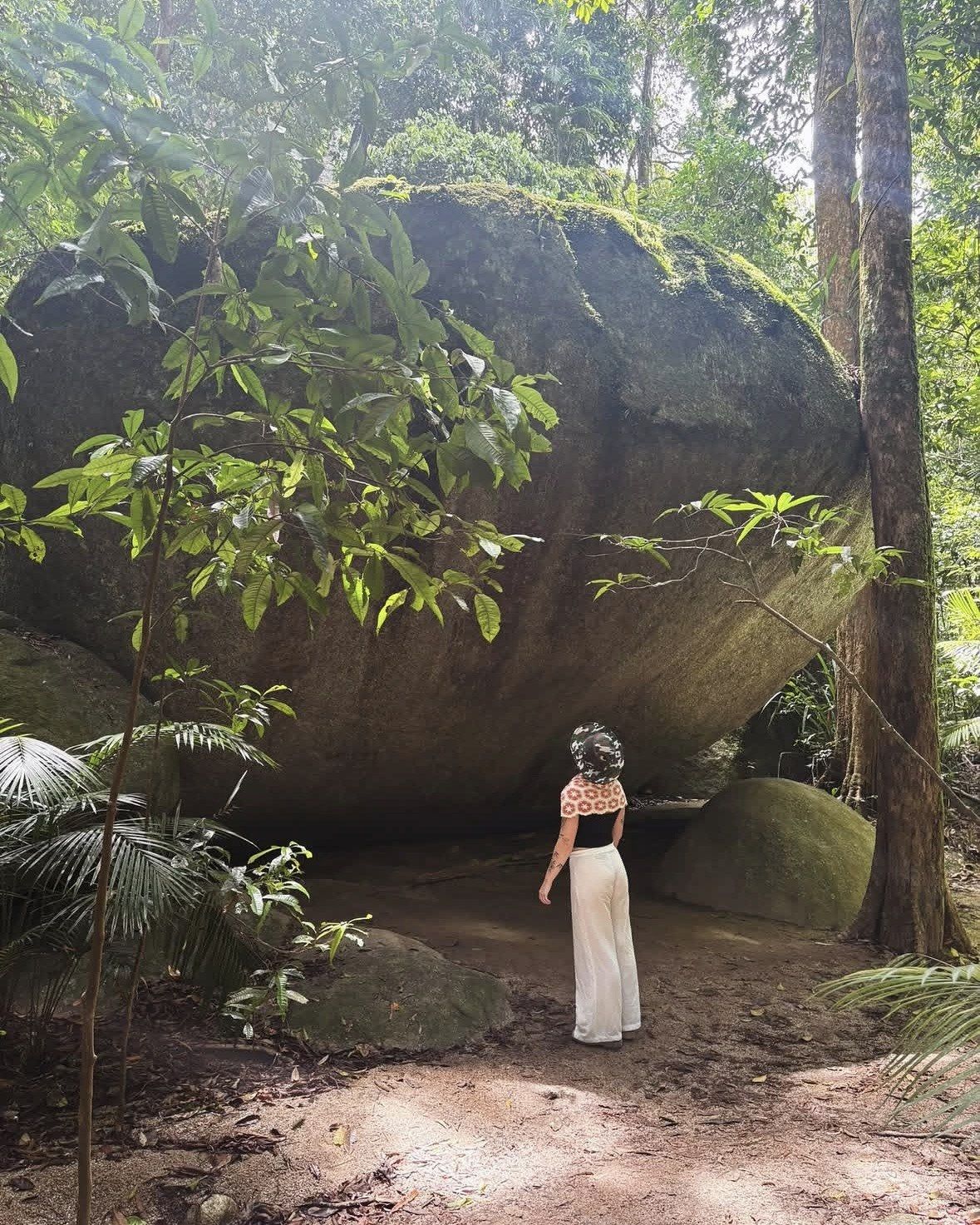
The regional tourism body gives one piece of positive advice on swimming: use designated freshwater swimming holes, such as Masons at Cape Tribulation. Masons sits on Cape Tribulation Road and describes its freshwater hole as croc free and stinger free.
Other names get traded in car parks and at campsites. No official page states a crocodile position for individual upstream creeks by name, which is exactly the information you would need, so do not build the day around someone's tip. The water in these spots is cold, shallow in places and deep in others, running over boulders and fallen timber, and it changes week to week.
Conditions that take a freshwater spot off the list for the day:
- Heavy rain upstream in the last day, even if it is dry where you are standing
- Water that has gone brown, or risen since you arrived
- Any crocodile warning sign, or any water where estuarine crocodiles are known to be seen
- Dusk and after dark, when official advice calls for extra care near water
- The period after flooding, when crocodiles can be pushed into unfamiliar waterways
- Fast current over boulders, or water deep enough that you cannot see the bed
The guided option with a swim included
This 2.5-hour UTV trip is the short, active way to get into the water without guessing at a creek: a guide, an ATV ride and private waterfall access and swim, from A$184 and rated 5.0 ★ (69 reviews).
★ 5.0/5 · 69 reviews
The Mossman River in the gorge
Mossman Gorge, the southern section of the national park on Eastern Kuku Yalanji country, is the place most people picture when they imagine a Daintree swim. The gorge visitor centre's official position is that swimming is not advised: the Mossman River is unpredictable and inherently dangerous, and nobody supervises it. Its guidance also warns that flash flooding can occur even when it is not raining at the gorge, especially after heavy rain upstream, and that strong currents, cold deep water and submerged rocks and logs are present even where the surface looks calm and shallow.
On wildlife the centre is measured: crocodiles are less likely in the gorge's fast-flowing freshwater, but they do live in the wider Daintree Rainforest, so stay wildlife aware. Plan the gorge as a walking stop instead: access is by shuttle from the Cultural Centre, and the Ngadiku Dreamtime Walk with Eastern Kuku Yalanji guides takes about 1.5 hours.
Pack swimwear, or leave it in Port Douglas
Pack it, but pack it as a bonus. One quick-drying set is enough, because the realistic options are a designated freshwater hole at Cape Tribulation, your accommodation's pool, or a guided trip with a swim built into the itinerary. If your Daintree day is boardwalks, a river cruise and the drive north from the ferry, the swimwear stays in the bag.
A guided swim stop removes the part you cannot judge from the road. The operator picks the spot, knows what the creek did overnight and times it against the weather. That counts for a lot in the green season, when roughly 75 to 90 per cent of the year's rain falls between about November and May, on a regional average near 3,000 mm. December to April is the wet low season on Tourism Australia's reckoning, humid and often raining, with the year's best waterfalls, and that is the same rainfall that lifts a quiet creek into something you stay out of.
The UTV Cassowary Falls and Daintree Rainforest Adventure is the trip on this site with a swim written into it: 2.5 hours, from A$184, rated 5.0 ★ (69 reviews), an ATV ride with a professional guide and exclusive private waterfall access and swim. Snacks are not included, a guide meets you at the start point where signs explain the arrangements, and cancellation stays open until 24 hours before the start time.
If swimming is not the point of your day, the best-rated full day here is the 9-hour small-group trip from Port Douglas: from A$270, rated 4.9 ★ (2,567 reviews), with Mossman Gorge, National Park fees, the Daintree River ferry crossing, a river wildlife cruise, Noah Valley north of the river, morning tea and a restaurant lunch. There is no swim stop on it, so pack accordingly.
Questions people ask
Are there crocodiles in the freshwater creeks upstream?
No official page gives a crocodile position for individual upstream creeks by name. The Mossman Gorge centre says crocodiles are less likely in fast-flowing freshwater, though they do live in the wider Daintree Rainforest. Douglas Shire Council's rule fills the gap: never swim where crocodiles may live, even without a warning sign.
Can you swim at Cape Tribulation beach?
No. The regional tourism body advises against swimming at any Daintree beach because crocodiles use them, and asks visitors to keep at least 5 metres from the shoreline. Marine stingers are the second reason, with risk peaking November to May. For the view, walk the Kulki boardwalk, 600 m return and about 10 minutes to an ocean viewing platform.
Do I need a stinger suit for a rainforest swim?
The stinger suit advice applies to the ocean. Surf Life Saving Queensland recommends a full-body suit for anyone entering the sea during the November to May season, and Douglas Shire Council says a lycra suit is sensible even inside a beach enclosure. A designated freshwater hole such as Masons at Cape Tribulation is described as stinger free, so a suit is not the issue there.
What happens to a swim stop if it rains?
The operator decides on the day, which is the main argument for taking your swim on a guided trip. Flash flooding can hit a gorge or creek even when it is not raining where you are standing, after heavy rain upstream. December to April is the wet low season, so keep a fallback for the afternoon.
Is there anywhere to swim at night in the Daintree?
Treat all water as off limits after dark. Official advice calls for extra care near water at night, crocodile activity peaks across the September to April breeding season, and nothing north of the river is patrolled. For the forest after dark, go on foot with a guided night walk.
Read also