In shortYes, and they are manageable. Top of the list is the estuarine crocodile, resident in the Daintree River and the tidal creeks, and Queensland's Be Crocwise instructions for it run to two lines: keep your body out of the water, keep 5 metres back from any edge. Second are marine stingers, present in the coastal water in every month of the year and most numerous from November to May. Snakes, cassowaries and the stinging tree are dealt with by staying on the boardwalks and keeping your hands to yourself.
5 mminimum distance to keep from any water edge
November to Maypeak season for marine stingers on the coast
September to Aprilcrocodile breeding season, when activity peaks
6–9am, 4–6pmhours when cassowaries most often step out
Are there dangerous animals in the Daintree Rainforest, and which ones matter
The honest ranking is short. Water is where the serious risk sits, for two reasons: estuarine crocodiles in the river and the coastal creeks, and marine stingers in the sea. Everything else people arrive worried about, snakes, cassowaries, leeches, mosquitoes, ticks and the stinging tree, is handled by staying on the formed track, keeping closed shoes on and keeping your hands off the plants either side.
Queensland's records for the Wet Tropics World Heritage Area list 154 reptile species, 139 mammals, 400 birds, 64 amphibians and 94 insects. Nearly all of them keep well away from people. The few that need a rule have one, published by the agencies that manage the place.
Every warning sign you pass has an author. Daintree National Park (CYPAL) is run jointly by the Jabalbina Yalanji Aboriginal Corporation and the Queensland Parks and Wildlife Service, on country whose Traditional Owners are the Eastern Kuku Yalanji people. The rules below come from them, from the Queensland Government and Douglas Shire Council.
| Hazard | Where it is | What keeps you clear |
|---|
| Estuarine crocodiles | The Daintree River, tidal creeks, beaches and the sea between Gladstone and Cape York Peninsula | Stay out of the water, keep at least 5 metres back from any edge, obey every warning sign |
|---|
| Marine stingers | Coastal water at any time of year, more frequently in the warmer months | Do not swim at Daintree beaches; wear a full-body stinger suit if you enter the ocean elsewhere |
|---|
| Snakes | Leaf litter, logs and track edges throughout the forest | Stay on the boardwalk, wear closed shoes, let any snake move off on its own |
|---|
| Southern cassowary | Roadsides between Cow Bay and Cape Tribulation, Stewart Creek Road, Dubuji boardwalk, Myall Beach, the Cape Tribulation foreshore | Never approach an adult or a chick, never come between a chick and its father, never feed them, do not stop the car to look |
|---|
| Stinging tree and other plants | Beside forest tracks, including regrowth and creek edges | Touch nothing you cannot name; keep children on the boardwalk |
|---|
| Mossman River | The gorge in the southern park section | Swimming is not advised: the river is unsupervised and flash flooding can occur even when it is not raining at the gorge |
|---|
Where crocodiles are and what the 5 metre rule means
Estuarine crocodiles live in the Daintree River and in the tidal creeks that cut across the beaches, all year. The Queensland Government records them anywhere between Gladstone and Cape York Peninsula, in any waterway and in the sea within that range, and notes they can hold still underwater, out of sight, for hours.
Be Crocwise comes down to two instructions: keep out of the water, and stay at least 5 metres back from the water's edge. Douglas Shire Council adds to that. Never swim in water where crocodiles may live, even when no warning sign is present. Obey the signs where they are posted. Remember that floodwaters can spread crocodiles temporarily into places they do not normally use. In protected areas, entering water above knee height near a warning sign, or anywhere estuarine crocodiles are often seen, is restricted.
Activity is not constant through the year. Queensland and Douglas Shire advice puts the peak in the September to April breeding season, and asks for extra care near water after dark. Apply the 5 metre margin at creek mouths and along the beach at Cape Tribulation the same way you would on the river bank, and do not clean fish or leave food scraps anywhere near the water.
For actually seeing one, get off the bank and onto a boat. A wildlife cruise on the Daintree River keeps a hull between you and the animal, and the operators work the mangrove channels and the mud banks where crocodiles haul out to bask. Cool mornings beat hot afternoons, because the local cruise operator notes crocodiles are harder to spot once the river warms up. Take an early departure if the choice is yours.
A guided day that does the river by boat
This 9-hour small-group day from Port Douglas includes the Daintree River wildlife cruise, the ferry crossing, National Park fees and a driver-guide with live commentary, so the water and the track decisions sit with someone who makes them daily. The rating stands at 4.9 ★ (2,567 reviews), with prices from A$270. Insect repellent and umbrellas are on board, and cancellation is open up to 24 hours before departure.
★ 4.9/5 · 2,567 reviews
Marine stingers and why nobody swims at the Daintree beaches
The jellyfish are why the sea here is treated as off limits rather than merely unpatrolled. Park managers state it plainly: dangerous stinging jellyfish can be in Daintree coastal water in any month, and they turn up more often once the water warms. The two that matter by name, box jellyfish and Irukandji, sit in tropical Queensland water year-round, and the Queensland Government marks November to May as the high-risk stretch. Surf Life Saving Queensland draws its stinger season over those same months, from Bustard Heads up past Port Douglas and further north, and its instruction for anyone going in is a full-body stinger suit.
At the Daintree beaches the stingers are the second reason to stay dry. The regional tourism body tells visitors not to swim at any Daintree beach, because crocodiles use them, and to keep 5 metres back from the shoreline. Walk the sand at Myall Beach and below the Kulki platform; stay out of the water.
Enclosures exist, but they are south of here. Douglas Shire Council describes the Four Mile Beach stinger enclosure at Port Douglas as giving a high degree of protection against box jellyfish, notes it is not 100 per cent stinger proof, and still recommends a full-body lycra suit inside it. If you want time in the water off the Cape Tribulation coast, do it from a reef boat with a stinger suit on and follow the crew's instructions. For a swim on land, use a designated freshwater swimming hole such as Masons at Cape Tribulation, or the pool at your accommodation.
- Full-body stinger suit for any ocean entry, in or out of the November to May window
- No swimming at Daintree beaches or creek mouths, signs or no signs
- Keep 5 metres back from the shoreline and from the edge of every tidal creek
- Designated freshwater swimming holes and hotel pools are the realistic places to cool off
Snakes, leeches, ticks, mosquitoes and the plant you must not touch
Snakes are part of a forest that holds 154 recorded reptile species, the amethystine python (Simalia kinghorni) among them, and almost all of them are moving away from you before you ever register them. What keeps the encounter uneventful is dull: stay on the boardwalk or the formed track, do not step into leaf litter, do not step over a log without seeing the far side, keep your hands out of hollows and from under rocks, and if a snake is on the path, stop and let it move off in its own time. You do not need to identify a single species to make that work. Wear closed shoes on every walk here.
The stinging tree is why guides keep telling people to walk with their hands down. Its leaves do the damage, and the track edges and creek banks are exactly where unfamiliar regrowth crowds in. Treat any leaf you cannot name as off limits, keep children on the inside of narrow sections, and do not grab a trunk or a vine for balance. On a guided walk the plant gets pointed out before you reach it.
Leeches show up on damp days, and mosquitoes and ticks come with any tropical forest. Long sleeves, trousers tucked into socks, closed shoes and repellent deal with all three, and a check of ankles, waistband and hairline after a wet-weather walk catches anything that hitched a ride. Some day tours keep insect repellent and umbrellas on board. The region averages about 3,000 mm of rain a year, so count on walking in rain at some point.
Cassowaries and the drive between Cow Bay and Cape Tribulation
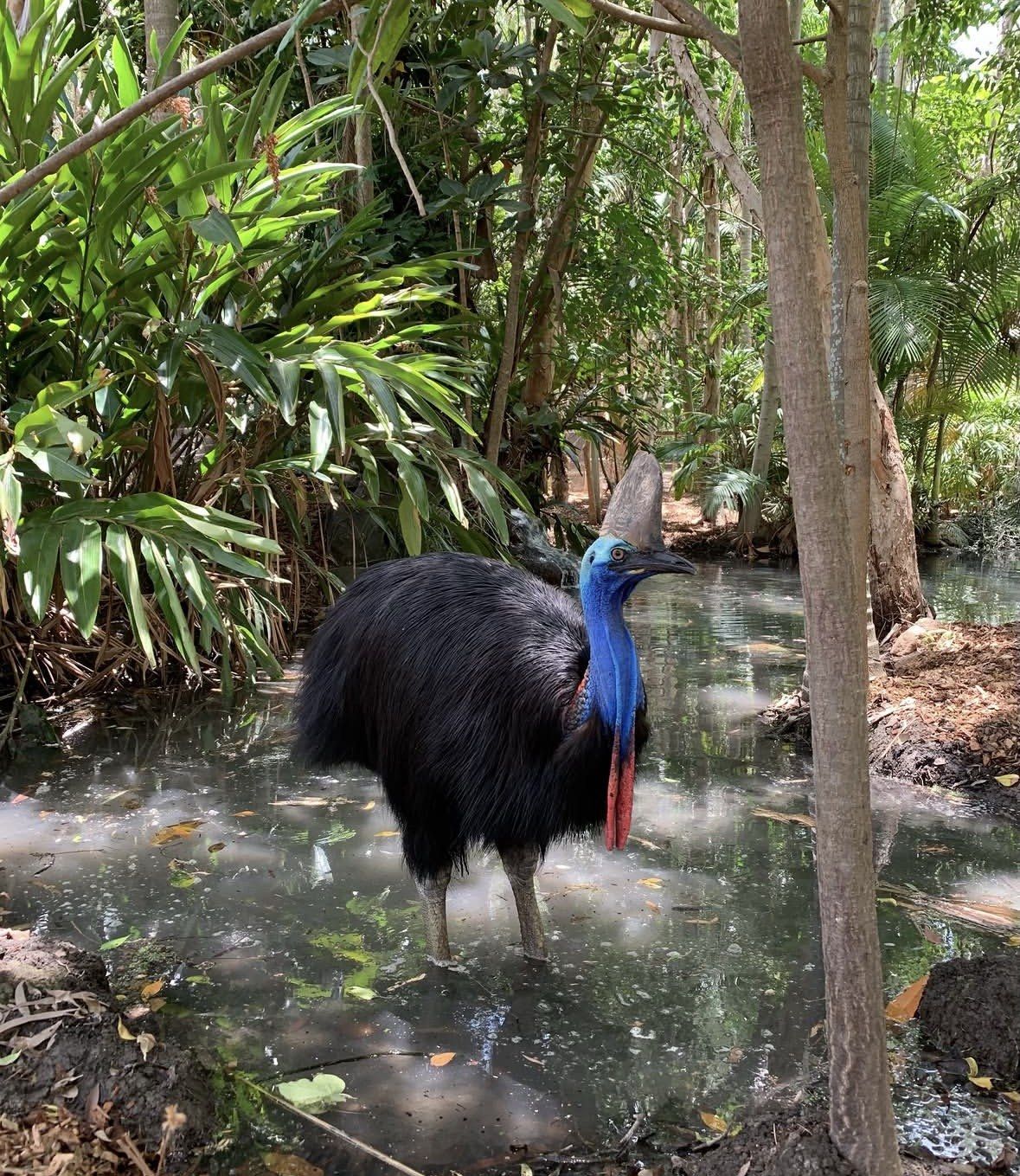
The southern cassowary is endangered and big enough to need its own rule. Why it needs one sits in the measurements: Queensland Government figures give a height of up to 2 metres, a weight of up to 76 kilograms for a female and 55 for a male, and a dagger-shaped claw reaching 120 millimetres, on legs that can break bones if the bird is cornered.
Official encounter advice has no grey area: never approach an adult, never approach a chick, never come between a chick and its father, keep your distance, and never feed them, which is illegal as well as dangerous. Breeding runs May to November, males incubate 3 to 5 eggs for about 50 days and then guard the chicks, so a single adult with striped youngsters behind it is a bird to walk away from. The birds eat fallen fruit from more than 238 recorded plant species, which is what brings them onto the forest floor and the roadside verges.
Behind the wheel the rules change. Slowing down through cassowary habitat and watching for an adult with chicks is what Parks asks of drivers, and the Queensland Government adds two more: a bird on the road is not a photo stop, and dogs travel leashed or stay at home. The hours when a bird is most likely to step out are 6 to 9am and 4 to 6pm, and the odds rise again across the October to April fruiting season. Local sighting records concentrate on Cape Tribulation Road between Cow Bay and Cape Tribulation, Stewart Creek Road at Daintree Village, the Dubuji boardwalk, Myall Beach and the Cape Tribulation foreshore. Vehicle strikes are the main direct threat to the birds in this region, so drive the habitat slowly even when the road looks empty.
Boardwalks, lookouts and guided walks keep you clear of all of it
The park's own infrastructure does most of the work. In the Cape Tribulation section the signature walks all run on boardwalks: Dubuji is a 1.2 km Grade 1 circuit of about 45 minutes, Madja covers 1.2 km in roughly 45 minutes, Jindalba at Cow Bay is 650 m return, and the Kulki boardwalk is 600 m return, about 10 minutes out to an ocean viewing platform. Boardwalk closures do happen, with Kulki reported shut for upgrades in the visitor guide, so confirm what is open before you count on a deck to keep you off the ground. A raised timber walkway over swamp forest keeps you out of the leaf litter, past the stinging leaves and away from the water's edge.
The southern section of the park, Mossman Gorge, handles its hazards with a bus. Vehicles stop at the Cultural Centre on Eastern Kuku Yalanji country and everyone continues on the shuttle, which leaves every 15 minutes between 8:00am and 5:00pm, every day of the week bar Christmas Day, with 4:30pm the last run back out of the gorge. There is no footpath from the car park into the gorge. The water carries the warning here, and it has nothing to do with animals: officially, swimming is not advised, because the Mossman River behaves unpredictably with nobody supervising it, a flood can come down while the sky above the gorge stays dry, and calm-looking stretches hide strong currents, cold depth and submerged rocks and logs. The centre also notes crocodiles are less likely in the gorge's fast-flowing fresh water, though they do live in the wider rainforest.
A guide takes the judgement calls off you. They know which creeks and beaches are closed to swimmers, which plant not to brush against, where the 5 metre margin starts at a creek mouth, and when to turn a group around. The river cruise built into the full-day tours keeps your water time inside a boat with commentary. After dark, use someone else's torch and someone else's route: that is when frogs, possums and insects are active and when you can least see your feet.
Pick a format where the hazards are already handled by people who work there every day.
- Grade 1 boardwalks keep you above the forest floor and away from water edges
- Lookouts and viewing platforms give you the river and the coast without standing on the bank
- Guides know the off-limits creeks and beaches and point out the stinging tree before you reach it
- A river cruise is the safe way to see a crocodile, and cool mornings are better than hot afternoons
Questions people ask
Can I swim anywhere in the Daintree?
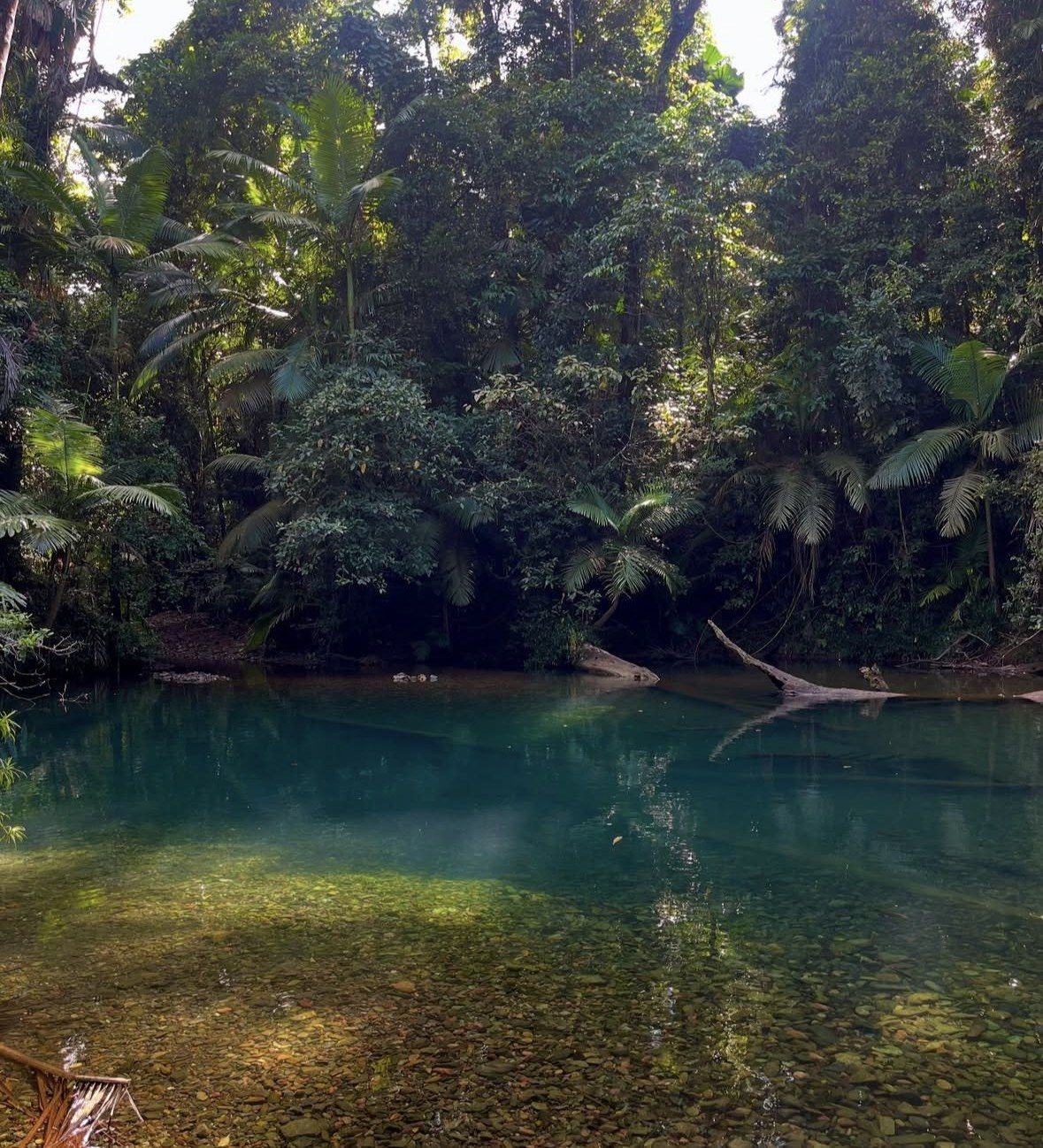
Treat the sea, the river and every creek as no-swim by default. The regional tourism body advises swimming only at designated freshwater swimming holes such as Masons at Cape Tribulation, and never at a Daintree beach, because crocodiles use them. At Mossman Gorge, on Eastern Kuku Yalanji country, the official guidance is that swimming is not advised. If a swim appears on a tour itinerary, it happens at the freshwater spot that operator has chosen, under that operator's instructions.
Do crocodiles live in the sea as well as the river?
Yes. The Queensland Government records estuarine crocodiles between Gladstone and Cape York Peninsula, in any waterway and in the sea within that area, and notes they can stay submerged and out of sight for hours. An empty-looking stretch of water proves nothing. The 5 metre rule applies on the beach and at creek mouths exactly as it does on the river bank.
Are the boardwalks safe for young children?
The signature walks are Grade 1 and flat when they are open, and the decking is what makes them suitable: you are off the forest floor and away from the water. Keep children on the decking, keep their hands off the plants either side, and hold onto them on any platform over water. Boardwalk access varies, so check what is open before you set out.
What should I wear for a rainforest walk here?
Closed shoes rather than sandals, long trousers you can tuck into socks, a long-sleeved top and repellent. That covers snakes underfoot, leeches on damp days, ticks and mosquitoes in one go. Add a poncho or an umbrella: the region averages about 3,000 mm of rain a year, and the wet low season runs December to April.
What happens if I need help north of the Daintree River?
Calling for help is the weak point. Coverage north of the river is patchy and the Noah Beach camping area has none at all, so get your maps and booking confirmations onto the phone while you are still in Mossman or Port Douglas. The one resupply point on the way is Diwan, between the ferry and Cape Tribulation, with fuel, a supermarket and a village store. On a guided day you travel with a driver-guide who knows the road and the plan for the day.
Read also